Tools and data
Software, web apps, and datasets built and released by members of the lab. Everything here is open and free to use.
Search
Add filters

Category
Keywords

autogradeR is expected to help instructors grade pre-defined assignments using a particular and relatively simple set of functions. Authograder generates basic templates that can only be accessed by instructors using a pre-defined encrypted password. The current release is based on RMarkdown files.


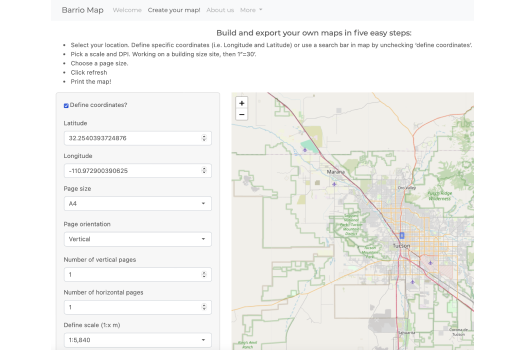
Barrio Map offers fundamental functionalities like finding locations by conducting searches or selecting coordinates. Users can select from predefined scales and export the scaled maps to particular page sizes. Maps generated using Barrio Map are formal descriptions of particular sites with defined values of resolution, scales, and explicit information on distances. Barrio Map, in conjunction with OpenStreetMaps, is written in R, with functionalities largely leveraged from packages such as Leaflet and Shiny.
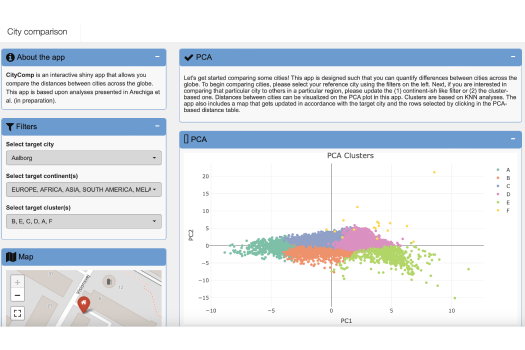
CityComp is a Shiny app developed to support the use of the comparative framework developed in Arechiga et al. (2023). In the app, users can directly visualize the results presented in the same paper. Specifically, a graphical and interactive version of Fig. 6 in the same paper is presented in the app. Users can further define a target city and estimate their similarity to cities across the globe. Dynamic filtering and mapping are implemented within the app.

Bayesian Additive Regression Networks. We apply Bayesian Additive Regression Tree (BART) principles to training an ensemble of small neural networks for regression tasks. Using Markov Chain Monte Carlo, Bayesian Additive Regression Net- works (BARN) samples from the space of single hidden layer neural networks that are conditioned on their fit to data. You can find more information in barnpy and its associated documentation
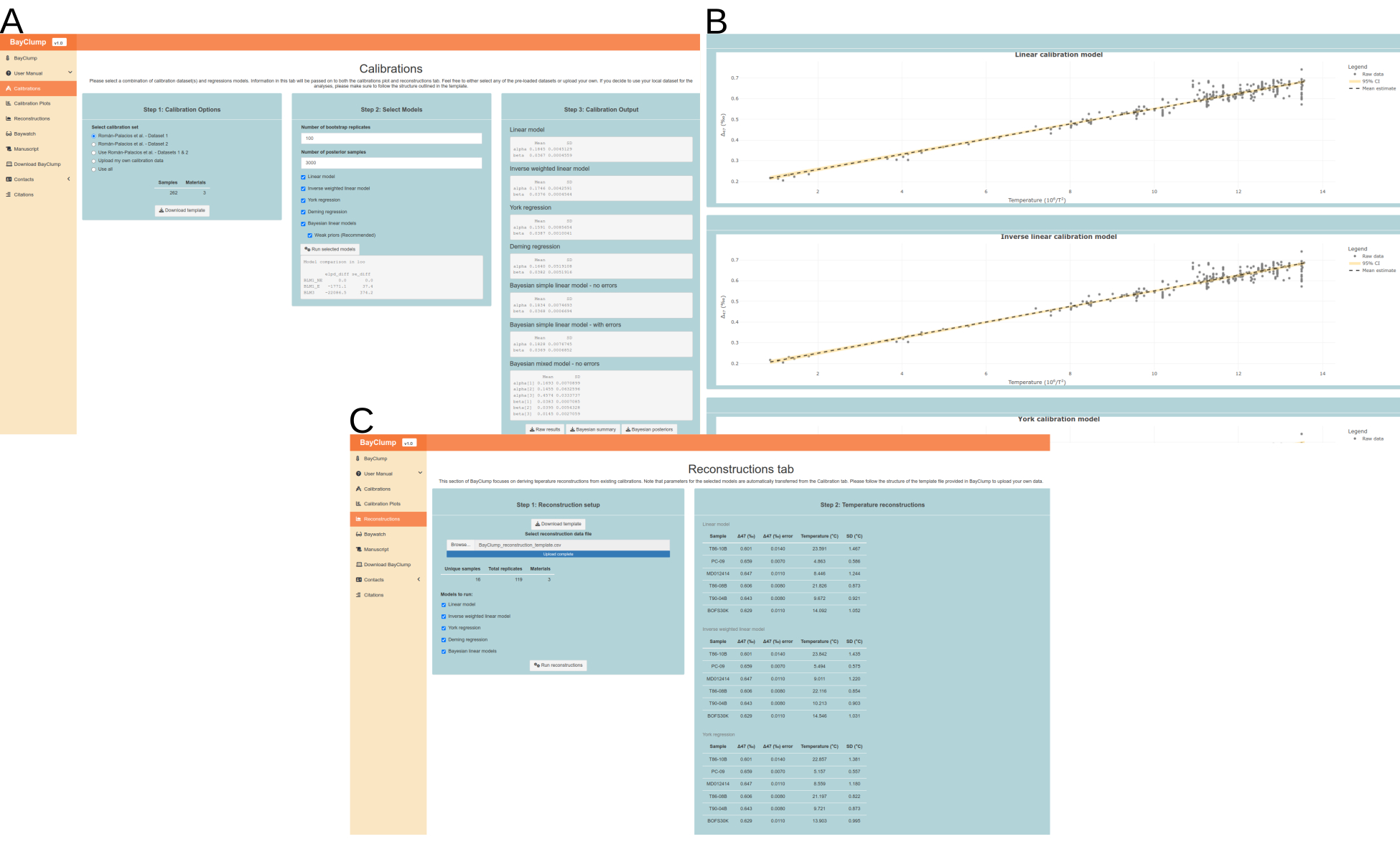
BayClump is a Shiny Dashboard application that is associated with the bayclumpr R package. All the functions implemented in BayClump are sourced from bayclumpr. We eveloped BayClump to allow users with less coding experience to be able to access standarized resources to calibrate and derive reconstructions using clumped isotope datasets.

bayclumpr is a self-contained R package that supports the use of Bayesian models and the analytical framework developed in Román-Palacios et al. (2022) for clumped isotope calibration, temperature reconstructions, and facilitatation of comparisons on Bayesian and classical models. bayclumpr fits both frequentist and Bayesian linear regressions to calibration datasets and performs temperature reconstructions under both frameworks.

A minimal GitHub Classroom replacement in R. Run a course on GitHub without GitHub Classroom: each student gets a private repo in a given organization, starter files get pushed in, and the student is added as a collaborator.
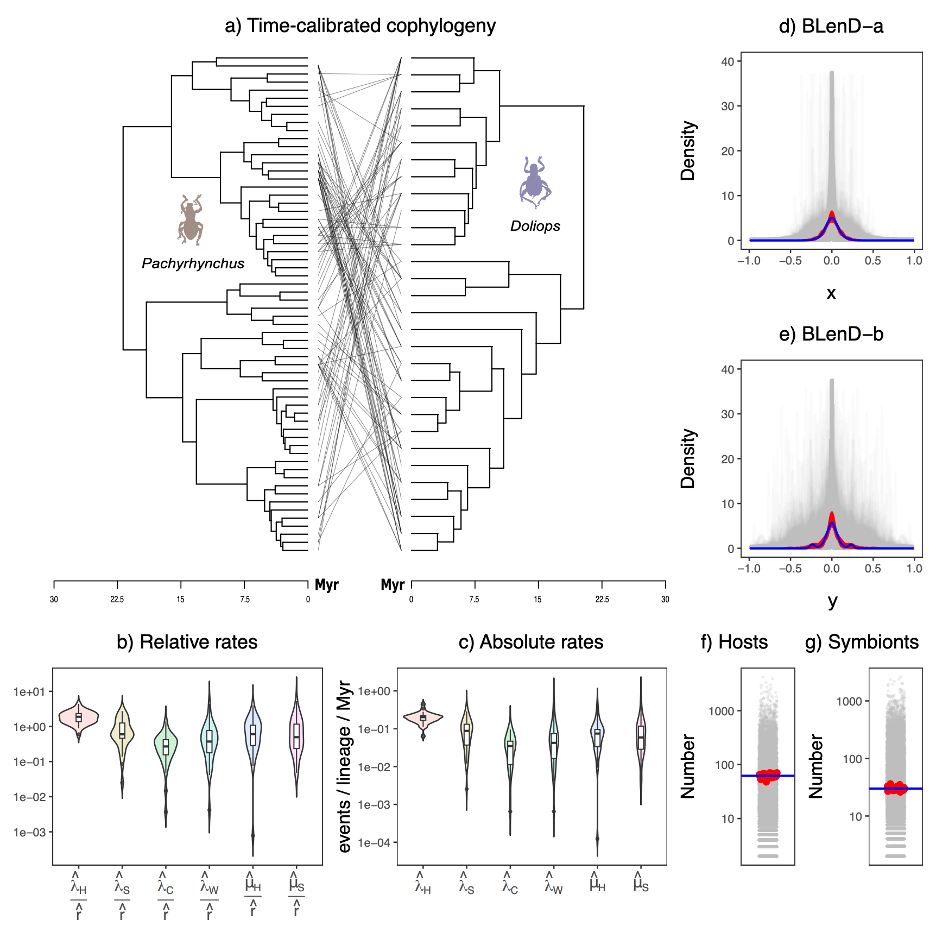
This project presents an Approximate Bayesian Computation (ABC) approach to estimating speciation and extinction rates from cophylogenetic systems. The rates of four types of speciation and two types of extinction can be inferred: host speciation (λH), symbiont speciation without host switching (λS), cospeciation (λC), symbiont speciation with host switching (λW), host extinction (μH), and symbiont extinction (μS). The speciation and extinction rates follow:
μH=ϵH(λH+λC)
μS=ϵS(λS+λC+λW)
where ϵH and ϵS range between 0 and 1.
We define the net diversification rate of the cophylogeny as
r=2∗rhost∗rsymbiontrhost+rsymbiont
where host=λH+λC−μH and symbiont=λS+λC+λW−μS are the net diversification rates of the host and symbiont clades, respectively.
For the user's information, some parameters are assigned a different name in the code: λW - exp_H, ϵH - mu_H_frac, and ϵS - mu_S_frac.
The tutorial provided here is the full procedure to estimate macroevolutionary rates from a given cophylogeny, using the BLenD-a / BLenD-b curves and tree sizes as summary statistics. This procedure is illustrated with a re-analysis of the cophylogenetic dataset from Van Dam et al. (2024)
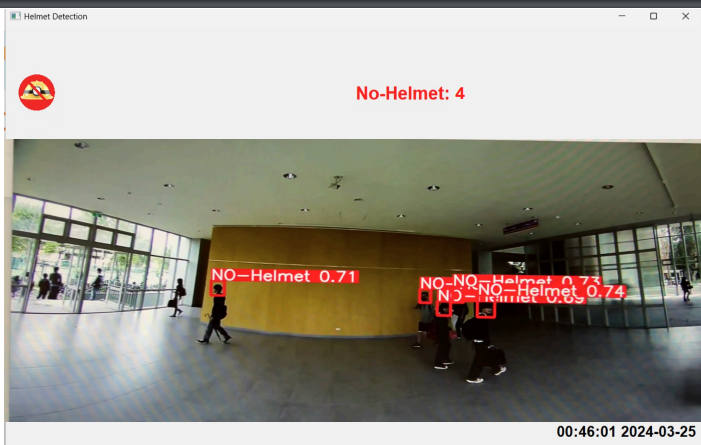
Enhannced PPE2 is a Human-Machine Interface (HMI) tailored for real-time object detection, with a specific focus on hard hat compliance monitoring in industrial settings. Although this project is tailored for hard hat compliance monitoring, the modular architecture allows easy adaptation for other applications like gengeral PPE detection including masks, goggles, vest and so on. This project focuses on developing the UI associated to the ML model detection algorithm.

This repo hosts a simple Firefox extension that checks on whether the requierements for a given program (or subplan) are being met by the student. This version focuses on Data Science and Information Science programs in InfoSci. However, this extension can be easily modified to enable other programs or subplans. It can also be adjusted in the requirements it check for. I did not implement an automatic submission.
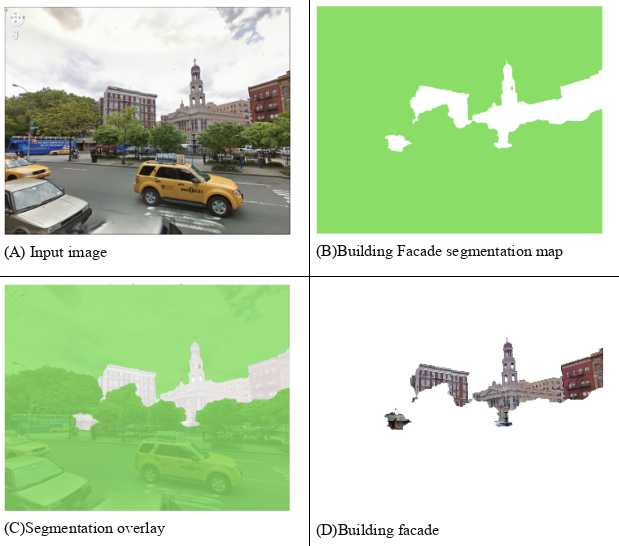
This Neural Network-based tool facilitates extraction of building facade color patterns from Google Street View Images.

Salphycon is a shiny app that extends the functionalities of the (phruta) R package. Salphycon is able to (1) find potentially (phylogenetically) relevant gene regions for a given set of taxa on GenBank, (2) retrieve gene sequences and curate taxonomic information from the same database, (3) combine downloaded and local gene sequences, and (4) perform sequence alignment, phylogenetic inference, and basic tree dating tasks. Both phruta and salphycon are focused on species-level analyses.

The phruta R package is designed to simplify the basic phylogenetic pipeline. All the code is run within the same program and data from intermediate steps are saved in independent folders (optional). phruta retrieves gene sequences, combines newly downloaded to local gene sequences, performs sequence alignments, and basic phylogenetic inference.
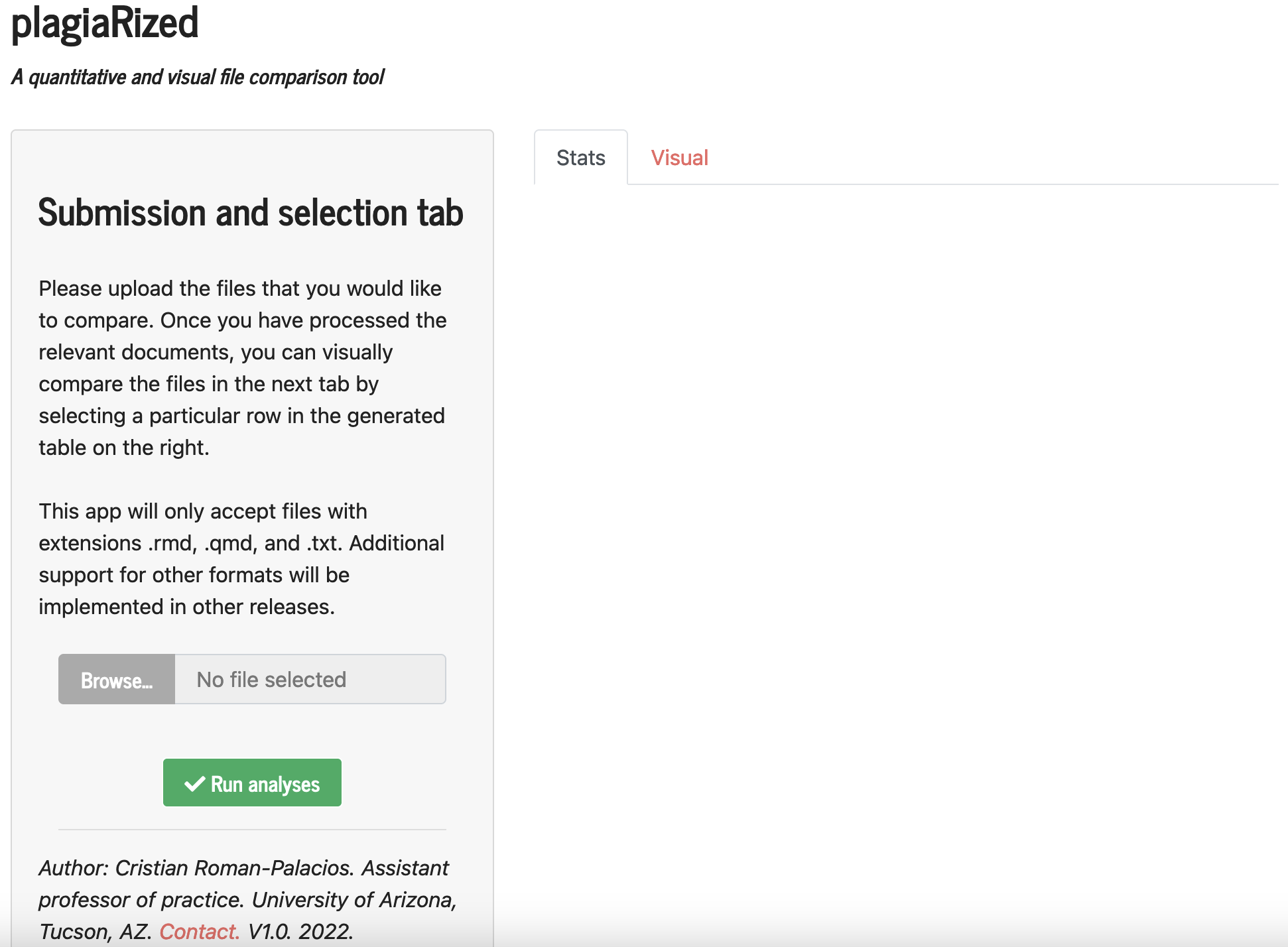
This is a basic shiny dashboard to perform pairwise comparison of different file submissions. The app is intended to help identify instances of potential plagiarism in coding-based assignments.

Chorus is a live polling platform designed for conferences, events, workshops, meetings, and similar events. Admins can create unique rooms, design questions, and enable access for attendees via unique tokens. Attendees can suggest answers and vote in real-time. Admins can manage questions, voting settings, and get summary statistics.

salphycon is a front end for the phruta R package. It's meant to introduce the early steps of a phylogenetics pipeline (taxon and gene selection, sequence retrieval, curation, and alignment) in a classroom setting, while staying flexible enough for a quick real research workflow, before moving to heavier computational steps like tree inference.
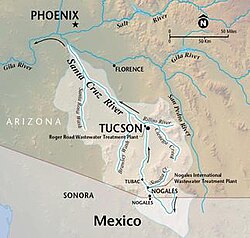
This tool predicts Escherichia coli (E. coli) levels in the Upper Santa Cruz River using a model trained on public data from 2009-2022. It is intended as a warning of possible high bacterial loads; water quality must still be verified using coliform testing procedures to ensure public safety.

ssarp (Species-/Speciation-Area Relationship Projector) is an R package that provides a suite of functions to help users create speciation- and species- area relationships for island-dwelling taxa using occurrence data from GBIF (Global Biodiversity Information Facility) or the user’s own occurrence data.

The ACC is the largest database of animal chromosomal counts. We have curated chromosome numbers across the animal Tree of Life to make data accessible for people interested in understanding the potential links between biological processes and patterns to broad chromosomal changes in animals.

The Animal Culture Database (ACDB) is a database of cultural behaviors across nonhuman animal species. It synthesizes current literature on intra-species behavioral variation in contexts such as communication, foraging, and migration, along with data on effects of human disturbances to the environment, to facilitate comparative research on interactions between animal social learning and climate change.
The data.table package enables high-performance extended functionality for data tables in R. treedata.table is a wrapper for data.table for phylogenetic analyses that matches a phylogeny to the data.table, and preserves matching during data.table operations.
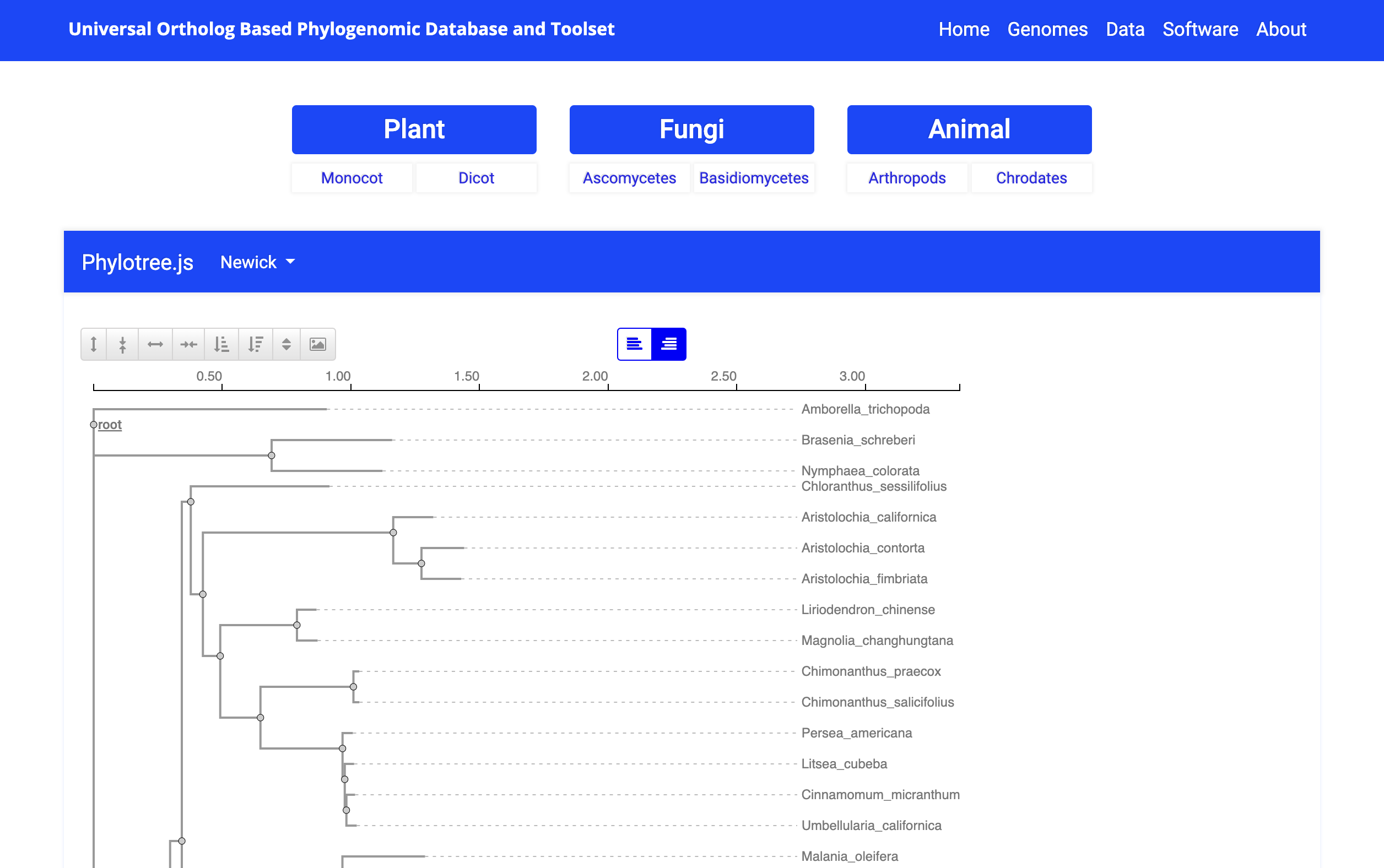
This research is being conducted with the following goals in mind:
- Facilitate evolutionary genomic analysis in the eukaryotic domain
- Make public genomic data more accessible by increasing information content per unit volume of data
- Develop improved methods and algorithms for genome informatics
- Streamline downstream analyses in genomic workflows
- Analyze patterns of genome evolution during the process of adaptation, speciation, diversification and domestication
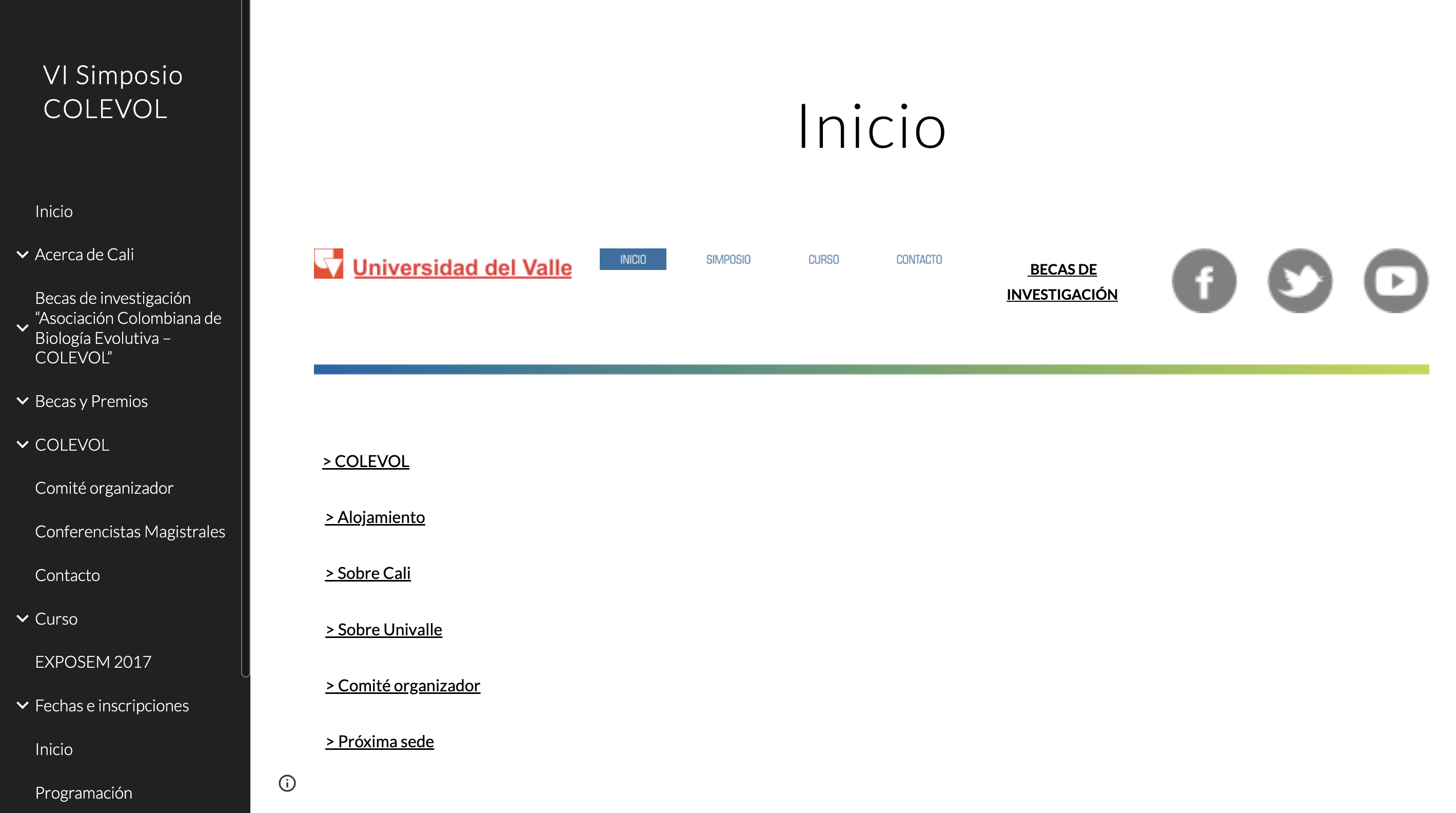
VI Simposio COLEVOL is a website guide to the COLEVOL-UNIVALLE 2017 conference. COLEVOL is the Colombian Association of Evolutionary Biology. This conference was held at the University of Valle in Cali, Colombia and aimed to serve as a symposium on evolutionary biology. This conference also offered a course on the basics of comparative phylogenetic methods. Overall, the event "fostered interaction and connections between students from remote regions of the country and prestigious academic and technological centers of thought in Colombia and around the world". Read more on the website!
The Colombian Association of Evolutionary Biology (COLEVOL) is a non-profit organization committed to the development and promotion of the study, research, and dissemination of evolutionary biology in Colombia. Some of its strategies include the annual publication of the Colombian Bulletin of Evolutionary Biology, the organization of the Colombian Symposium on Evolutionary Biology every two years, and the establishment of regional working groups in various departments of Colombia.
Since its inception as the Colombian Network of Evolutionary Biology, the Association has organized five symposia: Universidad de los Andes (2008), Universidad del Valle and ICESI (2009), Universidad de Antioquia and CES (2011), Universidad Central (2013), and Universidad del Quindío (2015). It also organized the IV Latin American School of Evolution (ELAEVO) in the city of Armenia (2015), in conjunction with the symposium of the same year.
Traditionally, the Colombian Symposium on Evolutionary Biology has been a significant event for the development of Colombian science. Understanding evolutionary biology as an interdisciplinary field, these events have fostered interaction and connections between students from remote regions of the country and prestigious academic and technological centers of thought in Colombia and around the world.
COLEVOL's mission, focused on promoting Colombian science, has successfully fostered dialogue among academics interested in evolutionary biology, including undergraduate and graduate students, as well as researchers based both within and outside the country. We have also benefited from the participation and collaboration on research projects of world-renowned evolutionary biologists such as Peter and Rosemary Grant, Mohamed Noor, Douglas Futuyma, and Michael Arnold.
The COLEVOL Regional Working Group of Valle del Cauca hopes to continue the previous achievements, through the organization of the VI Colombian Symposium on Evolutionary Biology and the Introductory Course in Phylogenetic Comparative Methods , to be held at the University of Valle, Cali, Colombia.
The events within the framework of COLEVOL-UNIVALLE 2017 will bring together researchers interested in Evolutionary Biology at the national and international levels. Both the Course and the Symposium will give students and professors from different Colombian academic institutions the opportunity to interact and establish new academic contacts with researchers from prestigious universities around the world.
We will have discussion sessions between the invited researchers and the participants to facilitate collaborations and agreements between institutions. These academic sessions are planned as working breakfasts and lunches with each of the speakers. Additionally, we are organizing other events to connect participants in a more informal setting (e.g., a farewell cocktail party).

The Southwest Center on Resilience for Climate Change and Health (SCORCH) brings together transdisciplinary research groups to conduct solutions-oriented team-science projects responsive to the health needs of arid lands communities adapting to climate change. The Integrated Data Visualization Core (IDVC) supports the overall Center mission through the provision of data science, visualization, and management expertise.