The Tortoise and the Finch: testing for island effects on diversification using two iconic Galápagos radiations
 Cristian Román-Palacios and John J. Wiens
Abstract
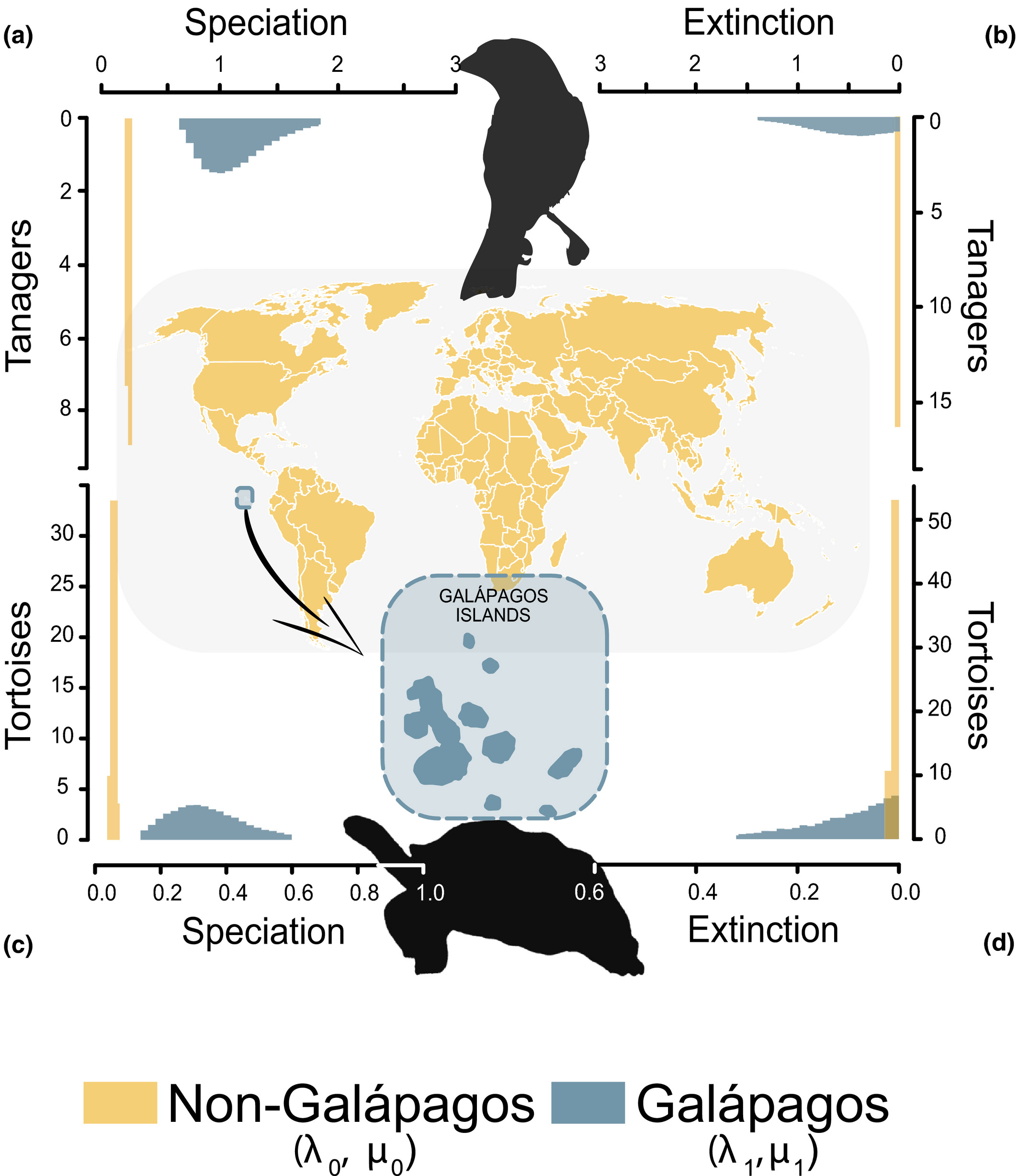
Aims: Islands are widely recognized as natural laboratories for evolutionary studies, but many questions about evolution on islands remain unresolved. Here we address two general questions from a macroevolutionary perspective. First, do lineages on islands have increased diversification rates relative to mainland lineages? Second, does the same geographical context (e.g., same archipelago) have similar effects on diversification in unrelated groups? We focused on Darwin’s finches and Galapagos tortoises, two endemic radiations from the Galapagos Islands, and the larger families in which they are embedded. Location: Global. Methods: We estimated a new time-calibrated phylogeny for tortoises (Testudinidae). Then, we examined their macroevolutionary patterns and compared them to those of Darwin’s finches and relatives (Thraupidae), using a published thraupid tree. Specifically, we estimated and compared diversification rates between islands and the mainland and between the Galapagos Islands and all other regions, using clade-based and species-based approaches. Results: Contrary to expectations, occurrence on islands in general did not significantly increase diversification rates in tanagers or tortoises. However, occurrence in the Galapagos Islands in particular was associated with increased speciation and diversification rates, and explained ~28% of the variation in diversification rates for thraupids and ~46% for testudinids. Both Darwin’s finches and Galapagos tortoises were unique within each family in exhibiting the highest diversification rates. The congruence of these macroevolutionary patterns between both radiations supports a strong “place-dependent” effect on diversification associated with the Galapagos. Finally, we found that Darwin’s finches diversified ~2–8 times faster than Galapagos tortoises. Main conclusions: Our results show that occurring on islands in general did not increase diversification rates in these clades, but occurrence in the Galapagos did. We also show that dramatic local-scale differences in diversification rates between clades in the Galapagos parallel global-scale differences in diversification rates between these families and between birds and turtles overall.