
Clumped isotope thermometry in foraminifera as a tool in paleoceanography: New planktic and benthic data and constraints on non-thermal effects
Aradhna Tripati, Hannah Tylee Tandy, A Villa, Randy Flores, Alexandrea Jay Arnold, Hannah M Carroll, Maxence Guillermic, Ingrid Maradiaga, Christian Blair, Bisrat Zerehaimanot, Dana Brown, Robert N Ulrich,  Cristian Román-Palacios, Julia de la Cruz, Mohan Kuppusamy, Dharmendra Singh, Raquel Bryant, Fengming Chang, Rob Eagle, Ceara Tomaiso, Thomas M. Marchitto, Rosemarie Came, and Jean Lynch-Stieglitz
Abstract
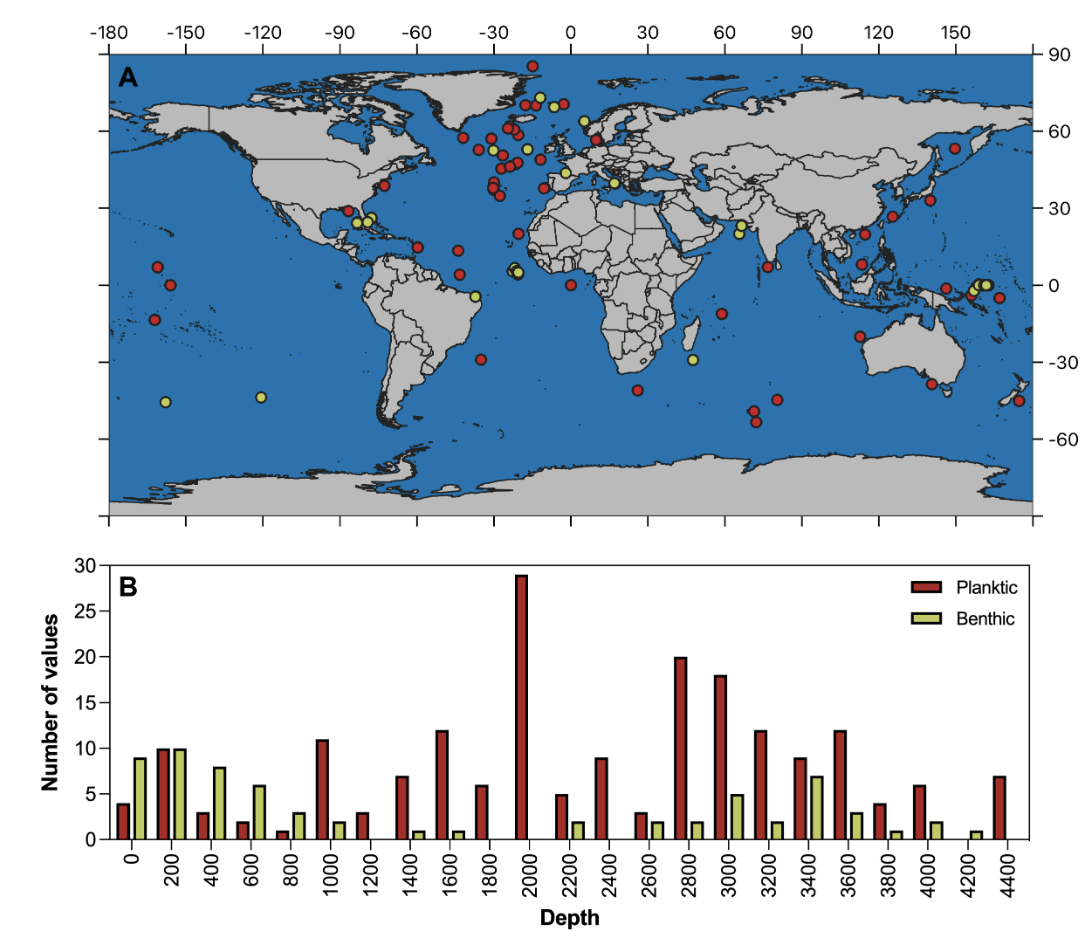
The carbonate ”clumped” isotope thermometer (Δ47) in foraminifera is increasingly being used to reconstruct ocean temperature. Here we address several less understood aspects of the proxy using a large dataset comprising new and reprocessed data. The Δ47-temperature relationship in foraminifera (n = 260) is described by Δ47 = 0.0374 ± 0.0013 106/T2 + 0.1744 ±0.0154, and in inorganic calcite (n = 118) by Δ47 = 0.0392 ± 0.0014 106/T2 + 0.1547 ±0.0165. Dataset-related differences explain only 11% of the variance; non-thermal effects explain up to 13% of the variance. We address the paucity of benthic data, establishing with more certainty that temperature sensitivity is indistinguishable from planktics and inorganic calcite. The large benthic dataset resolves a previously uncharacterized correlation with [CO32-] that is small (ΔΔ47/ΔCO32- slope = 0.00019 {plus minus}0.00004, n = 66; R2 = 0.315, p <0.01). We report a multivariate regression to account for both temperature and Δ[CO32] for all benthics (epifaunal and infaunal), with Δ47 = 0.152 ± 0.049 + 0.03865 ±0.00376 x 10⁶/T2 + 0.000150 ±0.0000601Δ[CO32-]. We apply these regressions to published Cenozoic benthic Δ47 data, with the multivariate benthic equation yielding temperature and δ18Osw values more consistent with independent proxies, models, and the broader understanding of ocean and cryosphere dynamics under different conditions, including across the Eocene-Oligocene Transition and the Early Eocene Climatic Optimum. In total, this work enables the application of clumped isotopes to foraminifera with a more realistic understanding of uncertainties.